

When Google’s AI Gets It Wrong: How Misleading Business Overviews Can Damage Reputations and Destroy Trust – Do Not Trust Their Overviews Blindly, They Can Be Completely Wrong!

This article has been written to raise awareness of a serious issue affecting many website and business owners. Take your time to read the entire article to fully understand the situation. Feel free to share it with your friends, on forums, and elsewhere to help raise further awareness.
Artificial intelligence is increasingly shaping how people search for information, evaluate businesses, and decide whom to trust. For many consumers, Google is the first stop when researching a company, checking whether a business is legitimate, or deciding whether to make a purchase. With the introduction of AI-generated search summaries and business overviews, users are increasingly relying on automated answers rather than investigating information themselves.
But what happens when those answers are wrong?
When Google’s AI incorrectly labels a legitimate business as a scam, or presents information about an entirely different company in response to a search about a specific business, the consequences can be serious. These errors can mislead consumers, damage reputations, undermine customer confidence, and potentially cause real financial harm. This is an issue that deserves greater public awareness.
The Problem With AI-Generated Business Information
AI-powered search tools are designed to make information easier to understand by summarising data from different sources across the internet. In principle, this can be useful. Instead of visiting multiple websites, users can receive a quick overview of a business, its reputation, and its history.
However, an AI-generated summary is not automatically accurate simply because it appears at the top of Google’s search results.
AI systems can misunderstand information, combine unrelated sources, confuse businesses with similar names, or produce conclusions that are not supported by reliable evidence. When this happens in a business overview, the result can create a false impression that is difficult for an ordinary user to recognise.
One particularly damaging example is when an AI overview suggests that a legitimate business is fraudulent or a scam without sufficient evidence to support that claim.
For a potential customer, such a statement can be enough to end the conversation immediately. They may decide not to purchase a product, cancel an enquiry, warn friends against using the business, or share the allegation with others.
The customer may never investigate further. They may never contact the business for clarification. They may simply accept Google’s AI-generated answer as fact.
When a Legitimate Business Is Wrongly Called a Scam
Being labelled a scam is one of the most damaging accusations a business can face. Trust is fundamental to almost every commercial relationship, particularly for online retailers, independent service providers, small companies, and businesses that depend on customers finding them through search engines.
A false or misleading AI-generated accusation can undermine years of work spent building a positive reputation.
Consider a legitimate business with genuine customers, completed transactions, and a history of providing its advertised services. A prospective customer searches for the company and sees an AI-generated overview suggesting that it is suspicious or potentially fraudulent.
Even if the business operates lawfully and delivers what it promises, the damage may already be done. The customer may leave with the belief that the company cannot be trusted.
The problem extends beyond one lost sale. If enough people encounter the same misleading information, the business could experience fewer enquiries, declining sales, reputational damage, and increased difficulty attracting new customers.
Small businesses are particularly vulnerable because they often lack the resources to challenge misleading online information or run extensive campaigns to correct it.
An AI-generated statement can take seconds to produce, but repairing the damage it causes may take months or years.
The Wrong Business, the Wrong Reputation
Another serious concern arises when someone searches for a specific business to determine whether it is legitimate, but Google’s AI-generated review discusses a different company.
Businesses can share similar names, operate in the same industry, or have overlapping keywords in their online presence. If an AI system fails to distinguish between them, information about one company may be incorrectly associated with another.
Imagine a customer researching Business A. Instead of accurately evaluating Business A, an AI-generated overview describes complaints, allegations, or negative experiences involving Business B.
The customer may reasonably assume that the information refers to the company they searched for. They may never realise that the summary has confused two separate businesses.
This creates an especially troubling situation: a company can suffer reputational damage because of allegations that have nothing to do with its operations, conduct, or customer service.
The affected business may have no connection whatsoever to the incidents described. Yet the search result can make it appear guilty by association.
This is not merely a technical inconvenience. It is a serious information-quality problem with potential consequences for both consumers and businesses.
Why Consumers Should Not Treat AI Answers as Proof
Google is a widely recognised platform, and information displayed prominently in its search results can carry considerable authority in the eyes of users. That makes accuracy especially important.
However, AI-generated summaries should not be treated as definitive evidence that a business is fraudulent, dishonest, or unsafe.
AI can produce confident-sounding statements that omit important context, misinterpret sources, or connect information to the wrong entity. A polished summary does not guarantee that the underlying facts have been verified.
Consumers should therefore examine the original sources, check whether allegations concern the correct business, look for reliable independent evidence, and give companies a reasonable opportunity to clarify disputed information.
A claim that a business is a scam should never be accepted solely because an AI-generated overview says so.
Accountability and Transparency Matter
Search engines have an important role in helping people find trustworthy information. As AI becomes more influential in search results, platforms must take the risk of misleading business summaries seriously.
This means improving business identification, distinguishing between companies with similar names, making sources easier to inspect, and providing effective ways to report and correct inaccurate AI-generated information.
When a system makes a serious allegation, users should be able to understand what evidence supports it. When a business is incorrectly represented, there should be a clear, accessible process for requesting a correction.
AI-generated content should also communicate uncertainty when reliable evidence is insufficient, rather than presenting potentially damaging conclusions as established facts.
Most importantly, correcting an error should not require a business to fight an opaque system without knowing why the misleading statement appeared in the first place.
Raising Awareness Is the First Step
Artificial intelligence can be a powerful tool, but its usefulness depends on the quality and accuracy of the information it provides. When AI-generated business overviews confuse companies or wrongly suggest that legitimate businesses are scams, the consequences can extend far beyond an incorrect search result.
They can affect livelihoods, customer relationships, public perception, and the survival of businesses that have done nothing wrong.
Consumers deserve accurate information. Businesses deserve to be represented fairly. And technology companies must recognise that their AI-generated answers can influence real decisions with real consequences.
The message is simple: do not automatically believe everything an AI-generated Google overview tells you about a business.
Check the facts. Read the original sources. Confirm that the information refers to the correct company. And remember that an AI-generated accusation is not proof of wrongdoing.
As AI increasingly influences what people believe, buy, and trust, public awareness and accountability are no longer optional. They are essential to protecting consumers and ensuring that legitimate businesses are not unfairly harmed by the very technology intended to help people find reliable information.
Notice: If you run a website or business, we strongly recommend checking your own website or business name in Google’s AI Overviews to see whether you are among those affected. To check, just type your website/business name in the search field and add words like “legit” or “scam” after the name. Recently, one of our friends noticed that his business is actually described as a scam if someone searches on google the business name and adds word “legit” after the name and clicks search even though the business has 0 negative reviews on the internet and is a legit business, not a scam. The overview even links to source pages where completely different businesses are described and not a single word mentioning the exact affected business name can be found on the source pages — a completely misleading overview made by Google AI. We’ve even found a few older cases, similar to our friend’s problem, that other people faced in the past, first is over a year old and second is 9 months old, meaning that the same problem is still happening even today and hasn’t been fixed for over a year now or longer. Check the screenshots below:
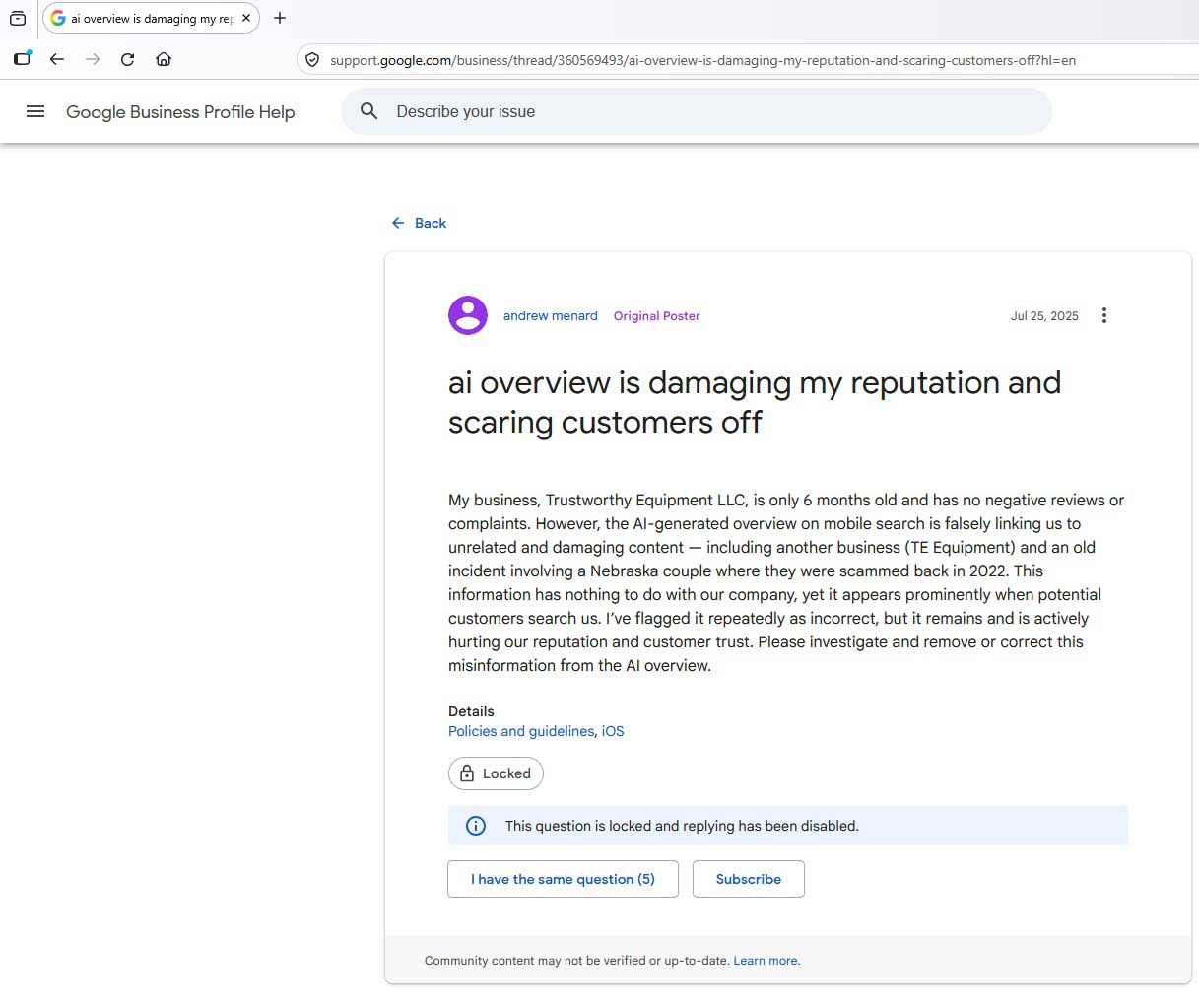
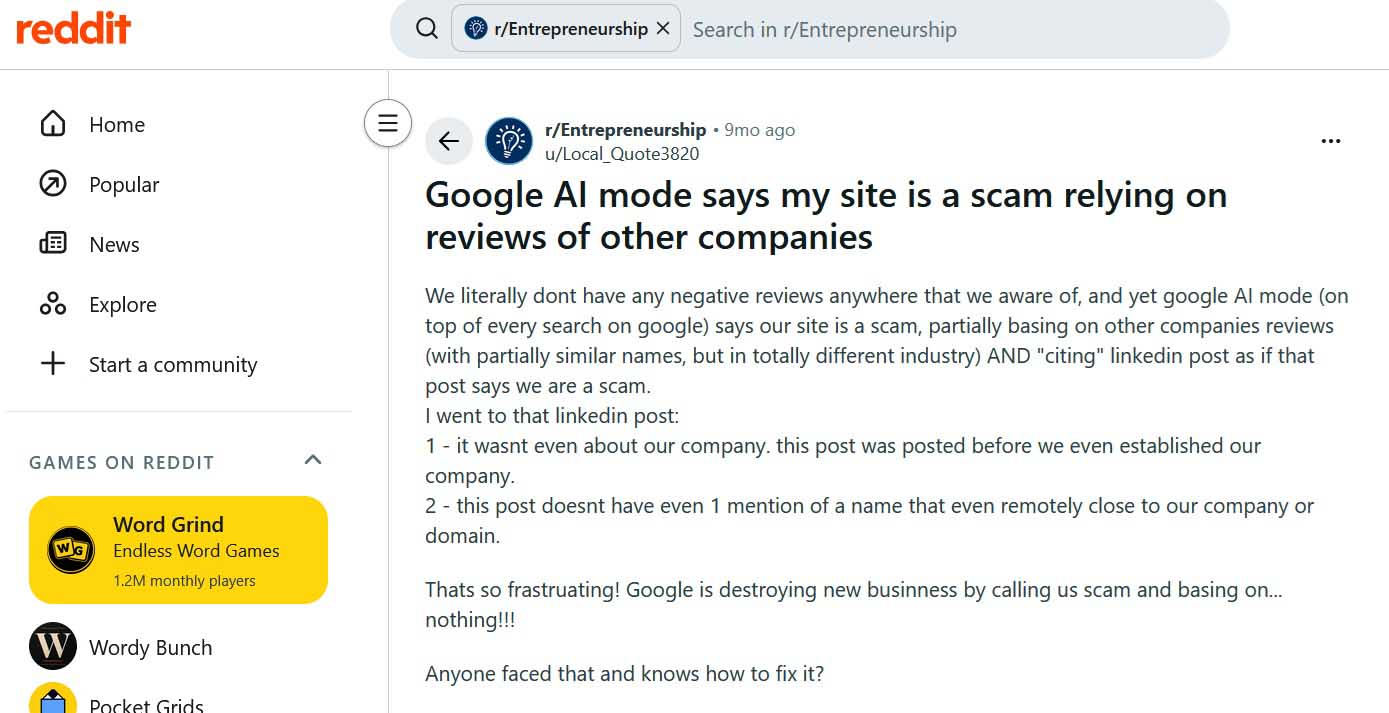
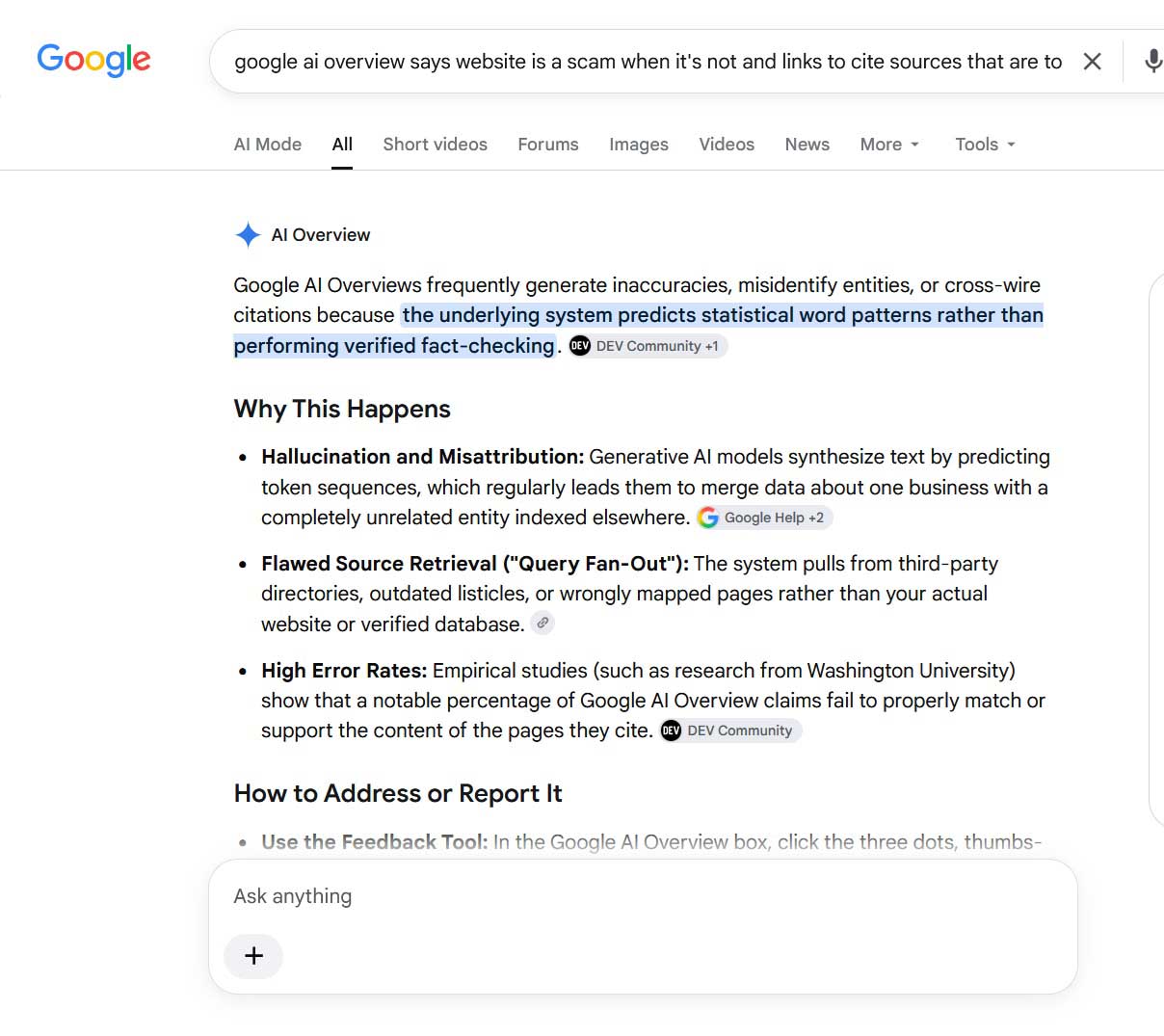
As you can see from the screenshot above, even Google’s own AI overview agrees that it can be completely incorrect. Again, do not trust their overviews (Google or any other AI) blindly, because they can be completely incorrect.
 Check out our marketplace
 Check out our marketplace