

DDR4 VS DDR5 RAM, which to choose?
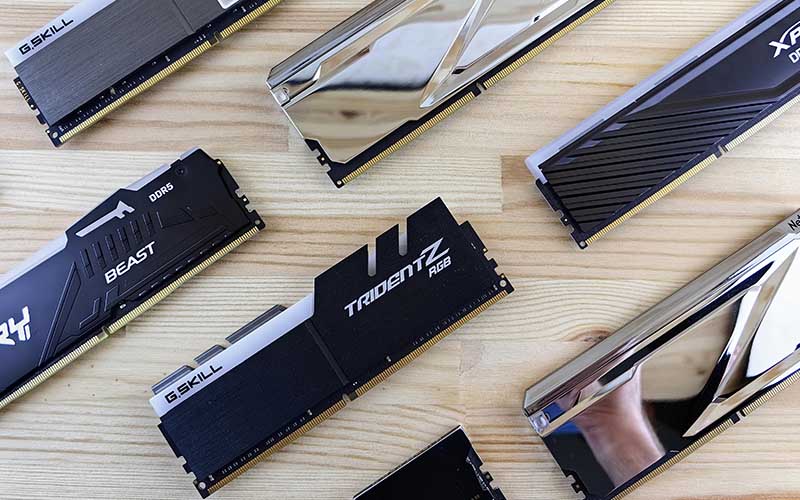
DDR5 is generally better than DDR4, but whether it matters for you depends on your specific use case and platform. Below is a detailed comparison of key differences and implications.
1) Performance
DDR5 Advantages:
Higher bandwidth: DDR5 modules start at higher data rates than DDR4, e.g., DDR5-4800 MT/s and up vs DDR4-3200 MT/s typical.
Improved throughput: More data per second improves performance in memory-intensive tasks (rendering, large datasets, virtualization).
DDR4 Strengths:
Lower latency: DDR4 typically has lower CAS latency numbers at similar speeds, which can mean better responsiveness in some workloads (e.g., gaming at certain settings).
Mature ecosystem: Optimized timings and profiles from years of refinement.
Takeaway:
DDR5 wins on raw bandwidth, while DDR4 can still deliver competitive latency in many real-world tasks.
2) Capacity
DDR5:
Supports much larger module densities (e.g., 32 GB+, scaling to 64 GB and beyond per stick).
Better for multi-tasking, servers, and content creation systems requiring large memory pools.
DDR4:
Typically available up to 16–32 GB per stick in mainstream markets.
Takeaway:
DDR5 enables higher capacities per DIMM, beneficial for heavy workloads.
3) Power Efficiency
DDR5 runs at a lower base voltage than DDR4 (1.1 V vs 1.2 V).
Incorporates on-DIMM power management (PMIC) for improved power delivery.
Result:
Better energy efficiency, especially in data centers and laptops.
4) Platform and Compatibility
Not interchangeable: DDR5 and DDR4 use different physical slots and electrical signaling.
Motherboard/CPU must specifically support DDR5 to use it.
Example: Intel 12th gen onwards often offers DDR5 support; AMD AM5 supports DDR5 exclusively.
Takeaway:
You must choose the memory type based on platform support.
5) Cost
DDR5 is more expensive per GB than DDR4 (especially near new generational launches).
DDR4 remains a cost-effective option for mainstream builds.
6) Real-World Use Cases
Use Case & Better Choice:
Gaming (budget/midrange) — DDR4 (cost-effective)
Gaming (high-end) — DDR5 (bandwidth advantage)
Content creation / video editing / simulation — DDR5 (higher bandwidth & capacity)
General office / web / media — DDR4 (adequate and cheaper)
Future-proofing — DDR5 (longer relevance)
7) Summary
DDR5 is technically superior overall — higher bandwidth, greater capacity, and better efficiency. However, DDR4 still offers excellent performance per dollar, particularly in systems that do not benefit significantly from extra bandwidth.
Choice is constrained by platform support and budget.
 Check out our marketplace
 Check out our marketplace