

What New SSDs Can We Expect in 2027? The Next Generation of Storage Technology
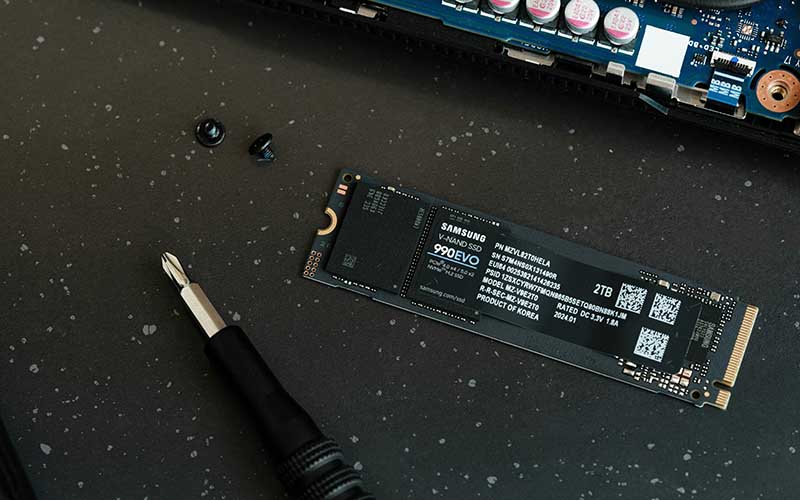
The solid-state drive (SSD) market is preparing for another major technological leap. While PCIe 5.0 SSDs are becoming increasingly popular among enthusiasts and professionals, manufacturers are already developing the next generation of storage devices. In 2027, we can expect faster interfaces, higher storage capacities, more advanced NAND flash memory and improved power efficiency.
However, the biggest changes might not necessarily be noticeable to everyday PC users. Artificial intelligence (AI), cloud computing and increasingly demanding data centre workloads are influencing how manufacturers develop their next-generation SSDs. These developments could eventually bring faster and more affordable storage to consumer computers as well.
So, what new SSD technologies and products can we realistically expect to see in 2027?
1. PCIe 6.0 SSDs Could Finally Reach Consumer PCs
One of the most interesting developments to watch in 2027 is the arrival of consumer-oriented PCIe 6.0 SSDs.
PCIe 6.0 doubles the theoretical bandwidth of PCIe 5.0, offering approximately 30.25 GB/s of bandwidth through an x4 connection, compared with approximately 15.75 GB/s for PCIe 5.0. This could translate into sequential transfer speeds approaching 28–30 GB/s in future SSDs under suitable conditions.
Enterprise PCIe 6.0 SSDs are already emerging, with manufacturers such as Micron and Samsung developing products for demanding server environments. However, consumer adoption will take longer because compatible controllers, motherboards and processors must become widely available.
Silicon Motion has indicated that its consumer PCIe 6.0 SSD platform could arrive towards the end of 2027. Nevertheless, widespread adoption will probably take longer.
For gamers and ordinary desktop users, PCIe 6.0 might initially offer limited practical benefits. Modern games and everyday applications rarely take full advantage of PCIe 5.0 speeds. However, professional video editing, large-scale data processing and AI applications could benefit considerably from the additional bandwidth.
2. Higher-Capacity SSDs With Next-Generation NAND
Another important development will be improvements in 3D NAND flash memory.
Manufacturers are continuously increasing the number of memory layers inside NAND chips, allowing them to store more information within the same physical space. In 2027, we should see further progress towards NAND architectures exceeding 300 layers, with some manufacturers already preparing significantly more advanced designs.
Micron, for example, has announced plans for its G11 NAND technology, which is expected to feature more than 400 layers. The company has outlined approximately twice the bit density of its G9 generation and a target for volume production in the second half of 2027.
Meanwhile, Kioxia and SanDisk have introduced their 10th-generation QLC 3D NAND technology, featuring 332 layers and up to 60% higher bit density than their eighth-generation technology.
These developments could eventually allow manufacturers to produce much larger SSDs without significantly increasing their physical dimensions.
For consumers, this could mean more affordable 4TB, 8TB and potentially even larger M.2 SSDs. Professional users and data centres could benefit from even greater capacities.
3. QLC SSDs Could Become More Popular
QLC (Quad-Level Cell) NAND stores four bits of information per memory cell, allowing manufacturers to achieve higher storage densities than traditional TLC (Triple-Level Cell) technology.
Although QLC SSDs have historically offered lower endurance and write performance than comparable TLC drives, improvements in controllers, firmware and NAND technology are gradually reducing these disadvantages.
In 2027, QLC technology could become increasingly important, particularly as demand for high-capacity storage continues growing.
AI infrastructure is one of the biggest reasons behind this development. Data centres require enormous amounts of storage for AI models, training datasets and other information. QLC SSDs provide an attractive balance between capacity and cost for these workloads.
For consumers, more widespread QLC adoption could mean cheaper high-capacity SSDs. However, TLC will likely remain the preferred option for enthusiasts who prioritise sustained write performance and endurance.
4. Faster and More Efficient SSD Controllers
NAND flash memory is only one part of an SSD. The controller is equally important because it manages data transfers, error correction, wear levelling and communication with the computer.
In 2027, we can expect new SSD controllers designed specifically for PCIe 6.0, alongside further improvements to PCIe 5.0 controllers.
These controllers will need to manage significantly higher data transfer rates while controlling heat generation and power consumption.
This is particularly important because high-performance PCIe 5.0 SSDs can already become extremely hot under heavy workloads. PCIe 6.0 will introduce additional engineering challenges, making cooling solutions and controller efficiency increasingly important.
We could therefore see more sophisticated SSD heatsinks, improved thermal management and better power efficiency across the next generation of storage devices.
5. AI Will Change the SSD Market
Artificial intelligence could become the biggest driving force behind SSD development in 2027.
AI systems require enormous amounts of information, and traditional memory technologies cannot always provide enough capacity at an acceptable cost. As a result, manufacturers are exploring new ways to use high-performance SSDs as part of the broader memory and storage hierarchy.
Enterprise SSDs with extremely high capacities and improved random-access performance will become increasingly important.
Some manufacturers are also exploring specialised flash memory architectures designed to deliver higher bandwidth and lower latency for AI workloads.
This does not mean that ordinary consumer SSDs will suddenly become AI-specific devices. Instead, technologies developed for data centres could eventually influence mainstream products, particularly in terms of controller performance, NAND density and energy efficiency.
6. Will SSD Prices Become More Affordable in 2027?
Pricing is another important question.
The SSD market has experienced supply constraints as manufacturers prioritise enterprise storage products and AI-related demand. However, TrendForce expects NAND flash supply conditions to gradually improve during the second half of 2027 as production capacity expands and manufacturing processes become more advanced.
This could create downward pressure on consumer SSD prices, particularly for high-capacity models.
Nevertheless, the situation is not entirely predictable. Strong demand from AI data centres could absorb much of the additional NAND production, while manufacturers may continue prioritising more profitable enterprise products.
Cheaper consumer SSDs are possible, but significant price reductions are not guaranteed.
2027 Could Be an Important Year for SSD Technology
The SSD market in 2027 could bring several important technological improvements. PCIe 6.0 consumer drives may finally begin appearing, next-generation NAND could deliver substantially higher storage densities, and QLC technology may become increasingly common.
However, the most significant developments will probably happen in enterprise storage, where AI infrastructure is creating demand for faster, larger and more efficient SSDs.
For ordinary PC users, 2027 might not necessarily be the year when everyone needs to replace their existing SSD. PCIe 5.0 drives will remain more than sufficient for most gaming and everyday workloads.
The technologies arriving in 2027 could establish the foundation for the next generation of consumer storage, making SSDs faster, larger and potentially more affordable in the years ahead.
 Check out our marketplace
 Check out our marketplace